

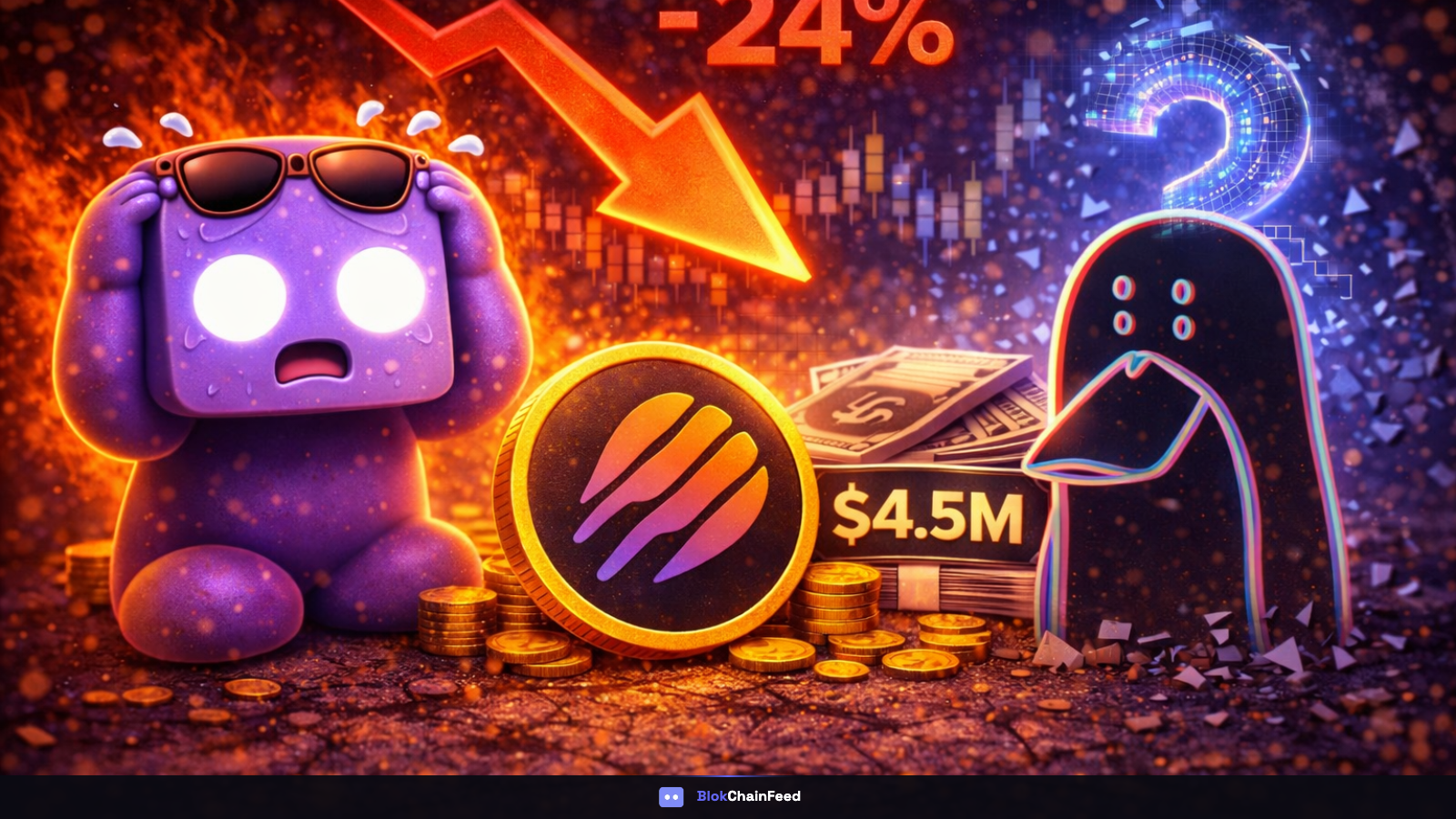
Meteora (MET) is trading at $0.17, down 24% on the week and 75% from its October 2025 all-time high of $0.6869, after on-chain investigator ZachXBT announced a “major investigation dropping February 26 on one of crypto’s most profitable businesses where multiple employees abused internal data to insider trade.” Within 24 hours of the February 23 post — which hit 7 million views, 24K likes, and 5.6K retweets — Polymarket spun up a $4.5 million prediction market with 22 potential targets. Meteora sits at 53% odds as the frontrunner. One anonymous trader placed a $5,891 bet on Meteora while simultaneously opening a 3x leveraged MET short on Hyperliquid. The trade-ahead playbook is already running.
The $4.5 million guessing game
ZachXBT named no company. He attached an image but offered no follow-up hints. The on-chain detective who helped trigger the first-ever cryptocurrency insider trading prosecution — the Coinbase Wahi case in 2022 — commands 900K+ followers and a track record that has landed people in federal prison. When he telegraphs, the market doesn’t wait for delivery.
Polymarket’s prediction market drew $4.5 million in volume across 22 possible outcomes within hours. The odds shifted dramatically as traders moved from guessing to analyzing:
| Target | Current Odds | Initial Odds |
|---|---|---|
| Meteora | 53% | 10–11% |
| Axiom | 13% | 15% |
| Pump.fun | 9–12% | 22% |
| MEXC | 7–8% | — |
| Jupiter | 7–8% | — |
| WLFI | 3% | 23% |
| Binance | ~2% | 15% |
Pump.fun and WLFI led early speculation; both collapsed as traders dug deeper. Meteora surged from a 10% outsider to a 53% frontrunner within 24 hours — a pattern that, as CoinDesk noted, suggests early speculation gave way to directional conviction.
Why the market is pricing Meteora as the target
The phrase “one of crypto’s most profitable businesses” does heavy lifting. Meteora’s treasury sits between $750 million and $1.6 billion. In May 2025, it generated $5.37 million in daily fees — the highest of any Solana protocol. Annualized revenue runs between $75 million and $115 million. By any measure, Meteora qualifies.
But profitability alone doesn’t explain 53% conviction. The allegation that “multiple employees abused internal data to insider trade” maps directly onto Meteora’s existing controversy. As Solana’s primary liquidity infrastructure — the protocol through which major token launches route their initial pools — Meteora employees have structural access to information about upcoming launches before public deployment. Three specific evidence threads fuel the speculation:
The TRUMP/MELANIA playbook
When the $TRUMP meme coin launched on Solana in January 2025, Meteora’s DLMM pools were the primary liquidity venue. Insiders used a single-sided liquidity strategy — depositing only tokens into Meteora pools without pairing with stablecoins — which programmed the AMM to continuously sell their holdings to incoming retail buyers. Within hours of the $MELANIA launch, the deployer wallet withdrew over $110 million in USDC. Analysts estimate retail investors collectively lost $4.3 billion on these two tokens while insiders extracted approximately $1.2 billion.
Ben Chow’s prior conviction
Meteora co-founder Ben Chow carries a prior conviction for insider trading in the Southern District of New York, involving illegal tipping of material nonpublic information in traditional finance. Chow resigned from Meteora in February 2025 after admitting he referred Hayden Davis and Kelsier Ventures to the $MELANIA project as token deployers. In a leaked video, Chow acknowledged his role, saying he felt “so sick” for enabling someone who shouldn’t have been enabled.
Active class action litigation
A securities class action (VOGT v. Meteora, S.D.N.Y.) alleges defendants secretly acquired ~95% of the $M3M3 token supply during its launch window. A second amended complaint accuses Chow of orchestrating a $57 million fraud through a “Meteora-Kelsier Enterprise,” bringing RICO claims and alleging a pump-and-dump pattern across $M3M3, $LIBRA, $MELANIA, $ENRON, and $TRUST tokens. Whistleblower communications in the filings confirm Hayden Davis acted under Chow’s instructions on 15+ token launches.
MET price data and volume
| Metric | Value |
|---|---|
| Current price | $0.17 |
| 7-day change | −24% |
| 24h volume | $19.8M (↑102%) |
| All-time high (Oct 2025) | $0.6869 |
| Decline from ATH | −75% |
| Market cap | ~$95M |
| Circulating supply | 499M MET (50% of max) |
MET dropped 6.5% immediately after ZachXBT’s post. It wasn’t alone — Hyperliquid’s HYPE fell 4.4% and Pump.fun’s PUMP dropped 6.6% as traders sold anything that could plausibly be the target. But MET’s sustained 24% weekly decline signals something beyond general nervousness. The token was already under pressure from TRUMP-linked wallets dumping their airdrop allocations — Arkham Intelligence identified three wallets linked to the TRUMP team that received a combined $4.2 million in MET tokens as top airdrop recipients and immediately deposited them to OKX.
The WLFI sideshow
The timing of ZachXBT’s announcement collided with World Liberty Financial’s worst day. On February 23, WLFI’s USD1 stablecoin briefly depegged, dropping to $0.994 with some exchanges reporting dips as low as $0.9802. Eric Trump deleted WLFI-related posts from X, including a retweet about new USD1 trading pairs on Binance. The WLFI token fell ~8% to around $0.107.
WLFI blamed a “coordinated attack” involving hacked co-founder X accounts, paid FUD influencers, and short positions. The stablecoin recovered its peg within 30 minutes. But Polymarket gives WLFI only 3% odds of being ZachXBT’s target — down from 23%. WLFI is politically toxic but doesn’t fit the “multiple employees abused internal data” framing. This looks like collateral damage from a market on edge, not the main event.
ZachXBT’s track record justifies the panic
This isn’t a random anon threatening to “expose” something. ZachXBT’s investigations have directly led to federal prosecutions, fund seizures, and asset crashes.
The most relevant precedent: the Coinbase Wahi case. In 2022, ZachXBT’s on-chain analysis identified a wallet purchasing tokens exclusively featured in upcoming Coinbase listings roughly 24 hours before publication. This work supported the DOJ/SEC case that became the first-ever crypto insider trading prosecution. Former Coinbase product manager Ishan Wahi received 24 months in federal prison. The parallel to “multiple employees abused internal data to insider trade” is hard to miss.
Beyond Wahi, ZachXBT has traced over $200 million in stolen assets across 25+ crypto hacks and earned a 50,000 ARKM bounty for linking the Lazarus Group to the $1.5 billion Bybit hack. Historical analysis shows affected assets typically undergo 50% to 90% price adjustments after his revelations. If Meteora is confirmed February 26, MET’s current 75% drawdown from ATH could accelerate substantially.
What this means for Solana’s DeFi credibility
Every leading candidate on Polymarket — Meteora, Axiom, Pump.fun, Jupiter — is Solana-native. Meteora isn’t a peripheral app — it’s integrated with Jupiter, Solana’s top aggregator, which routes trades through Meteora pools. Contamination at the liquidity layer contaminates everything above it.
Solana DEXes reported $1.5 trillion in trading volume in 2025, and institutional ownership of SOL surged 841% by Q3 2025. Spot Solana ETFs launched in late 2025. If ZachXBT’s investigation confirms systemic insider trading at a core infrastructure layer, it could undermine the institutional credibility narrative driving SOL’s adoption cycle.
Meow, co-founder of both Jupiter and Meteora, has denied wrongdoing and hired Fenwick & West for an independent investigation with results promised to be made public. The legal defenses are being built, but the court of Crypto Twitter may render its verdict first.
What to watch on February 26
Forty-eight hours separate the market from either vindication or surprise. The asymmetric risk is stark: if Meteora is named, the existing 75% drawdown from ATH likely accelerates toward the 50–90% impact range historically associated with ZachXBT revelations. If it isn’t, there’s a reflexive relief rally — but the class action lawsuits, the $4.3 billion in retail losses, and Ben Chow’s insider trading conviction don’t disappear.
Key levels for MET:
Support: $0.15 (psychological) / $0.12 (swing low cluster) / $0.069 (ATL zone)
Resistance: $0.20 (immediate) / $0.23 (pre-ZachXBT level) / $0.30 (structural recovery)
Short-term (24–48h): Expect continued selling pressure with 102% volume surge indicating active distribution. A confirmed Meteora naming on Feb 26 triggers a flush toward $0.12–$0.15.
Medium-term (1–2 weeks): If Meteora is NOT the target, relief rally toward $0.23–$0.25. If confirmed, sustained downtrend toward ATL zone.
Bullish scenario: Different company named → MET reclaims $0.20, targets $0.25
Bearish scenario: Meteora confirmed → flush to $0.10–$0.12, potential cascade below $0.10 if exchange delistings follow
Invalidation: Daily close above $0.25 invalidates the bearish thesis.
Either way, February 26 will define whether Solana’s liquidity backbone can survive its biggest credibility test yet.

Reported by BlokchainFeed's research team — crypto journalists and market analysts with 50+ years combined experience covering blockchain and digital assets.
Meet Blok →