

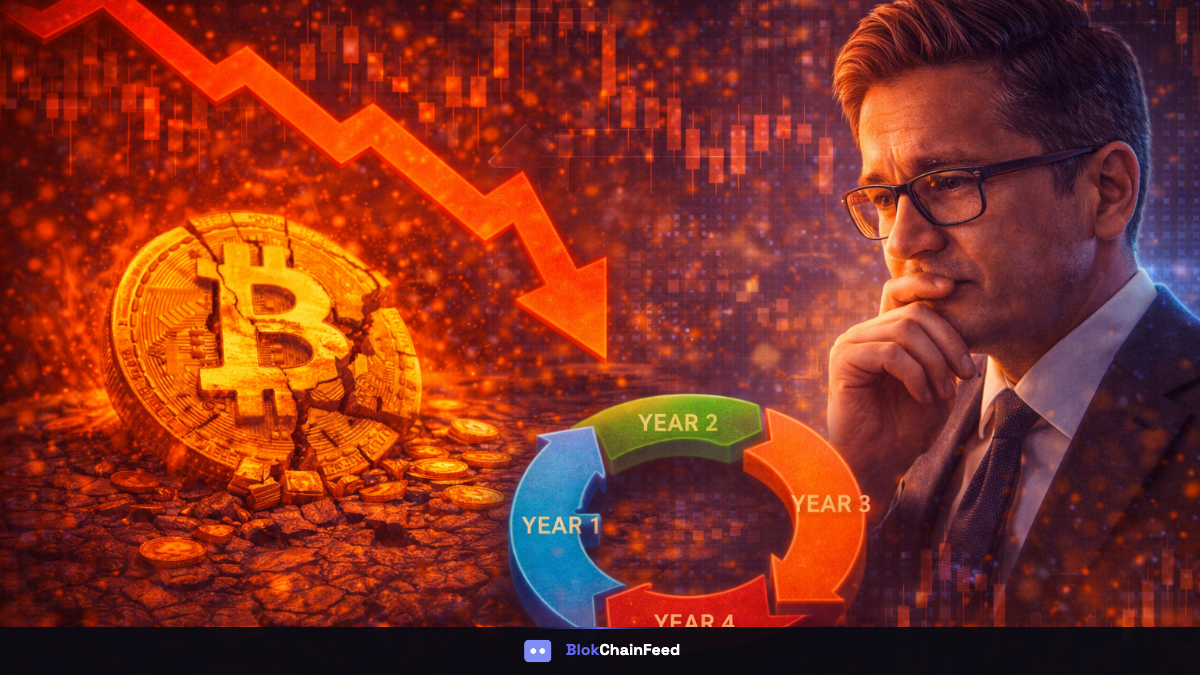
Bitwise Asset Management CIO Matt Hougan identifies the cryptocurrency market’s four-year cycle as the primary factor behind Bitcoin’s recent decline, as the flagship digital asset posts approximately 20% year-to-date losses through February 2026.
Cyclical Pattern Over Panic
Hougan’s analysis frames the selloff as a predictable phase within Bitcoin’s established boom-and-bust pattern tied to halving events, rather than a fundamental breakdown in the asset’s thesis. Bitcoin’s February selloff reflects orderly deleveraging rather than capitulation, with leverage normalizing and volatility declining despite the roughly 20% drawdown from year-start levels.
The four-year cycle theory centers on Bitcoin’s programmed halving events, which occur approximately every four years and reduce miner rewards by half. Historically, these halvings have triggered bull markets followed by extended corrections as speculative excess unwinds. The most recent halving occurred in 2024, suggesting the market may be entering a consolidation phase consistent with previous cycles.
Institutional Perspective Shifts
Grayscale characterizes Bitcoin as primarily a tech trade currently, not digital gold, noting that regulatory clarity and blockchain innovation could set the stage for the next recovery leg. This assessment aligns with Hougan’s cycle-based interpretation, suggesting institutional players view the correction as structural rather than catastrophic.
While Bitcoin’s latest plunge has traders panicking, long-term investors are identifying opportunity in the dislocation, a typical pattern during mid-cycle corrections when weak hands exit and conviction buyers accumulate.
Bitcoin Price Context and Outlook
Bitcoin‘s 20% decline stands in contrast to its meteoric gains during 2024’s post-halving rally, when institutional adoption via spot ETFs drove prices to new all-time highs. Crypto ETFs continue gaining institutional traction amid volatility, suggesting the infrastructure for long-term growth remains intact even as prices compress.
Hougan’s emphasis on cyclical patterns offers a framework for understanding current weakness without dismissing Bitcoin’s long-term trajectory. If historical precedent holds, the current consolidation phase could extend for months before the next accumulation cycle begins, potentially setting up for another bull phase aligned with the 2028 halving event.

Reported by BlokchainFeed's research team — crypto journalists and market analysts with 50+ years combined experience covering blockchain and digital assets.
Meet Blok →